The Journey to an MBA: A Strategic Guide to Acing Your Entrance Exams
Prof. Sony Varghese, Dean Academics
Introduction: The value of an MBA as the first step towards leadership
The value of an MBA as the first step towards leadership. Choosing to pursue an MBA or PGDM is a defining decision. One that signals your intent to grow into a leader, not just in title but in action and impact. The choice of a good business school is crucial, and so is the path to reach it. Yet, before you walk through the gates of a top B-school, there is a formidable challenge that awaits you: cracking the entrance exams.
These tests, whether CAT, XAT, MAT, NMAT, SNAP, or others, are not just filters for eligibility. They’re benchmarks of your problem-solving ability, time management, and resilience under pressure. Preparing for them can be overwhelming, especially with a full-time college schedule or job. But with the right strategy, discipline, and mindset, it is entirely possible to excel.
Let’s explore how.
Understanding the Landscape of MBA Entrance Tests
Each entrance exam is a different beast. Understanding their structure, difficulty, and evaluation criteria is the first step in creating an effective study plan.
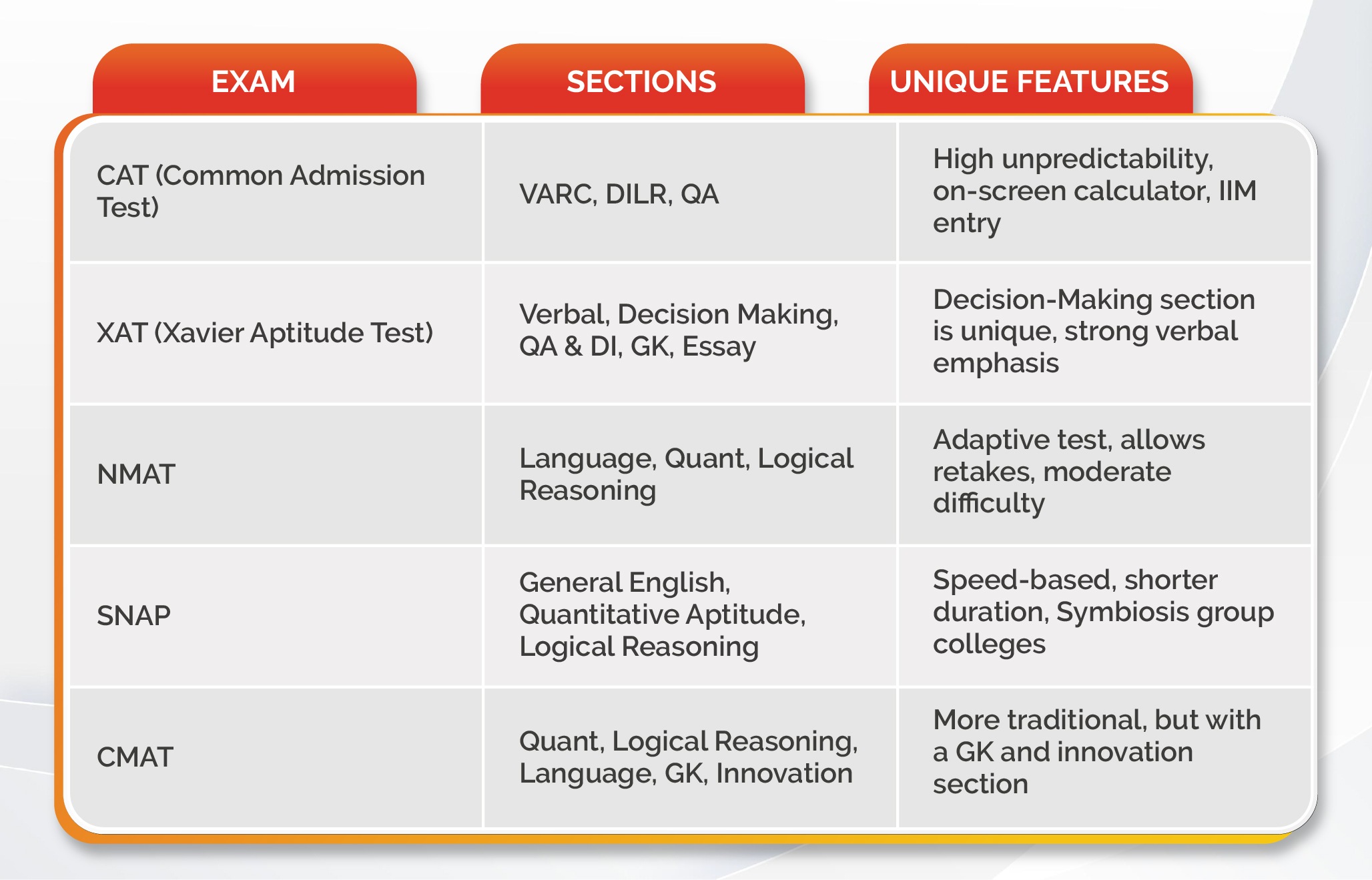
The major management entrance exams in India differ significantly in structure and focus, offering candidates various pathways depending on their strengths and preferences.
The CAT (Common Admission Test) includes sections on VARC (Verbal Ability and Reading Comprehension), DILR (Data Interpretation and Logical Reasoning), and QA (Quantitative Ability). The CAT is known for its high unpredictability, providing an on-screen calculator and serving as the gateway for entry into Indian Institutes of Management (IIMs).
XAT (Xavier Aptitude Test) stands out due to its distinctive Decision Making section, alongside Verbal, QA & DI (Quantitative Ability and Data Interpretation), General Knowledge (GK), and Essay writing. XAT places a strong emphasis on verbal skills, making it unique compared to other exams.
NMAT comprises three core areas: Language Skills, Quantitative Skills, and Logical Reasoning. The NMAT is adaptive, adjusting question difficulty based on responses, and allows candidates to retake the test, which makes it moderately challenging and flexible for test-takers.
SNAP (Symbiosis National Aptitude Test) focuses on General English, Quantitative Aptitude, and Logical Reasoning. Designed to be speed-based with a shorter duration, SNAP is primarily accepted by Symbiosis group colleges.
CMAT (Common Management Admission Test) remains a more traditional exam, covering Quantitative Techniques, Logical Reasoning, Language Comprehension, General Knowledge, and an Innovation section. This blend offers a classic testing approach while incorporating contemporary elements through GK and innovation questions.
Each exam has its own features and unique advantages, catering to a diverse set of management aspirants with different academic strengths and career goals.
How to prepare strategically
Begin with Self-Assessment: Know Where You Stand
Before investing in any prep strategy, take at least one mock test for the exam you're targeting. This serves two purposes:
- It diagnoses your current aptitude across areas like quantitative reasoning, verbal ability, data interpretation, and logical thinking.
- It reveals your instinctive approach to problem-solving and your current stamina for time-bound tests.
Use this diagnostic test as your baseline.
Understand the Exam Structure
Each exam has a different flavour. For example:
- CAT emphasizes analytical reasoning and time management across three sections.
- XAT introduces a unique decision-making section and includes GK.
- NMAT is computer-adaptive and allows multiple attempts.
- MAT offers flexibility—conducted four times a year in both CBT and paper formats.
Spend time understanding the format, number of questions, difficulty level, and time limits.
Build Conceptual Strength First
MBA exams test fundamental quantitative and verbal skills. A good preparation strategy begins with mastering the basics:
- Quantitative Ability: Focus on arithmetic, algebra, geometry, and number systems.
- Verbal Ability: Improve reading speed, comprehension, and vocabulary.
- Data Interpretation: Practice interpreting tables, graphs, and charts quickly.
- Logical Reasoning: Solve puzzles, arrangements, coding-decoding problems.
- Decision-Making (XAT): Practice case scenarios with ethical/business dilemmas.
Use standard materials like Arun Sharma, Nishit Sinha, or TIME IMS notes. For MAT, also look at solved papers for its specific question style.
Practice with Mock Tests
Mock tests are where you test your stamina, strategy, and stress management. Analyze your performance deeply after each mock—identify weak areas, timing issues, or careless errors.
For MAT and NMAT, which are conducted more frequently, treat every exam attempt like a mock—these are opportunities to learn and improve.
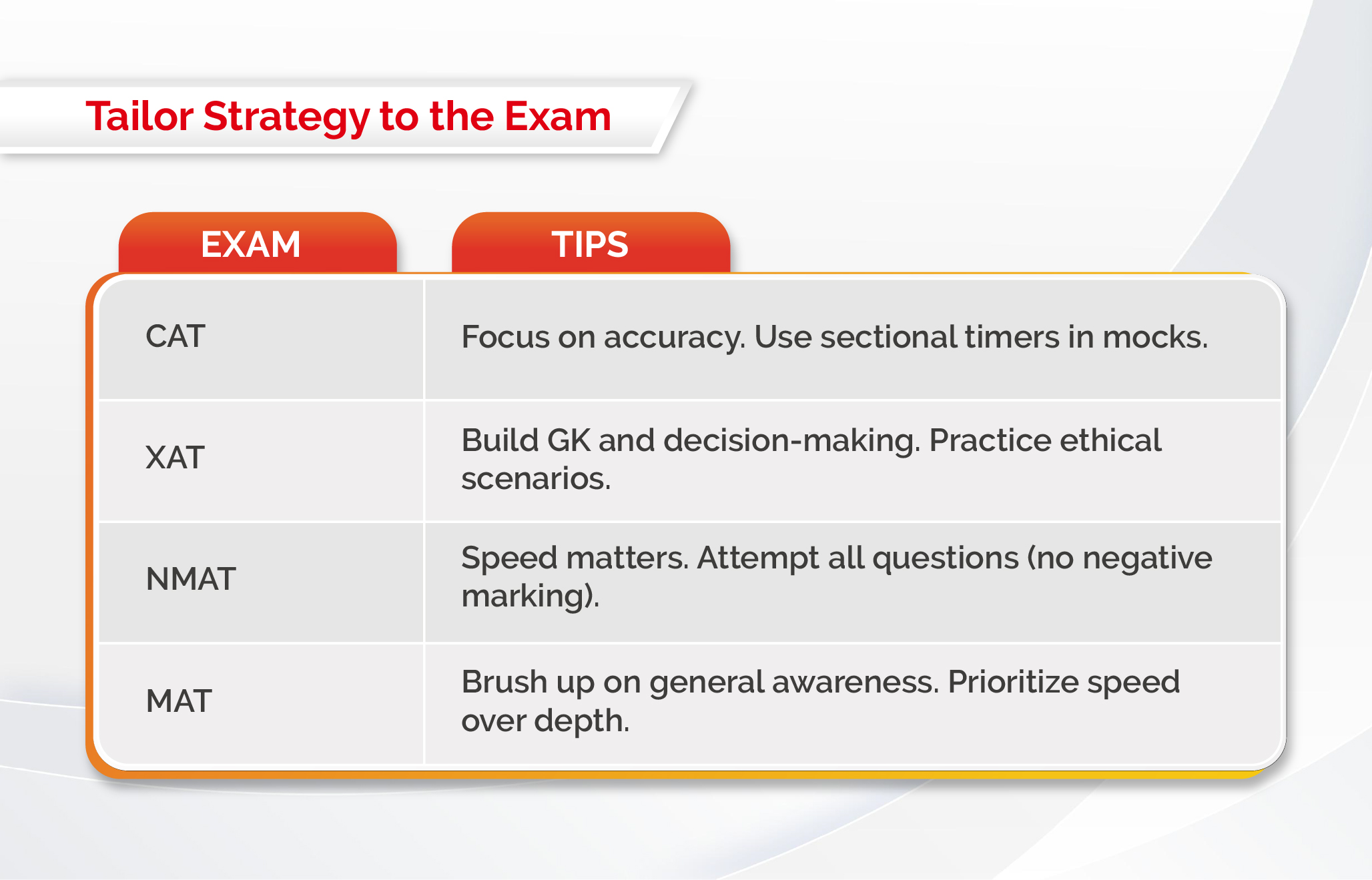
When preparing for management entrance exams, it is crucial to tailor your strategy to suit the unique demands of each test.
For the CAT exam, the primary focus should be on accuracy. Candidates are advised to practice using sectional timers during mock tests to enhance time management and precision.
The XAT exam requires aspirants to strengthen their general knowledge (GK) as well as decision-making skills. Practicing ethical scenarios is especially important for success in the decision-making section of this exam.
In the NMAT exam, speed plays a vital role. Since there is no negative marking, candidates should attempt all questions to maximize their scores.
For the MAT exam, brushing up on general awareness is essential. Here, it is more important to prioritize answering questions quickly rather than spending too much time on any single topic, as speed is valued over depth of knowledge.
Building a Study Plan: Strategy Over Slog
A good preparation plan spans 4 to 6 months, though some students manage with 3 months of focused effort. Here’s how to structure your preparation:
1. Divide Time by Phase
- Foundation Phase (1–2 months): Strengthen basics in Quant, brush up on grammar and reading speed, understand logical patterns.
- Practice Phase (2–3 months): Solve sectional tests, increase speed, work on accuracy.
- Mock & Revision Phase (last 1–1.5 months): Intensive mock testing, performance analysis, stamina-building.
2. Weekly Timetable Template
- Quantitative Aptitude: 3–4 days/week (topics like Arithmetic, Algebra, Geometry, Numbers)
- Verbal Ability & RC: Daily reading + 2 sessions/week for grammar and vocab
- Logical Reasoning & DI: 2–3 days/week for puzzle solving, DI sets
- Mock Tests & Analysis: Once a week in early phase; 2–3/week later
Which Entrance Exam Suits Your Profile
While there’s no hard rule that a certain profile should apply only to a certain exam, it’s good to have a broad understanding of what exams to go after if you have a certain background.
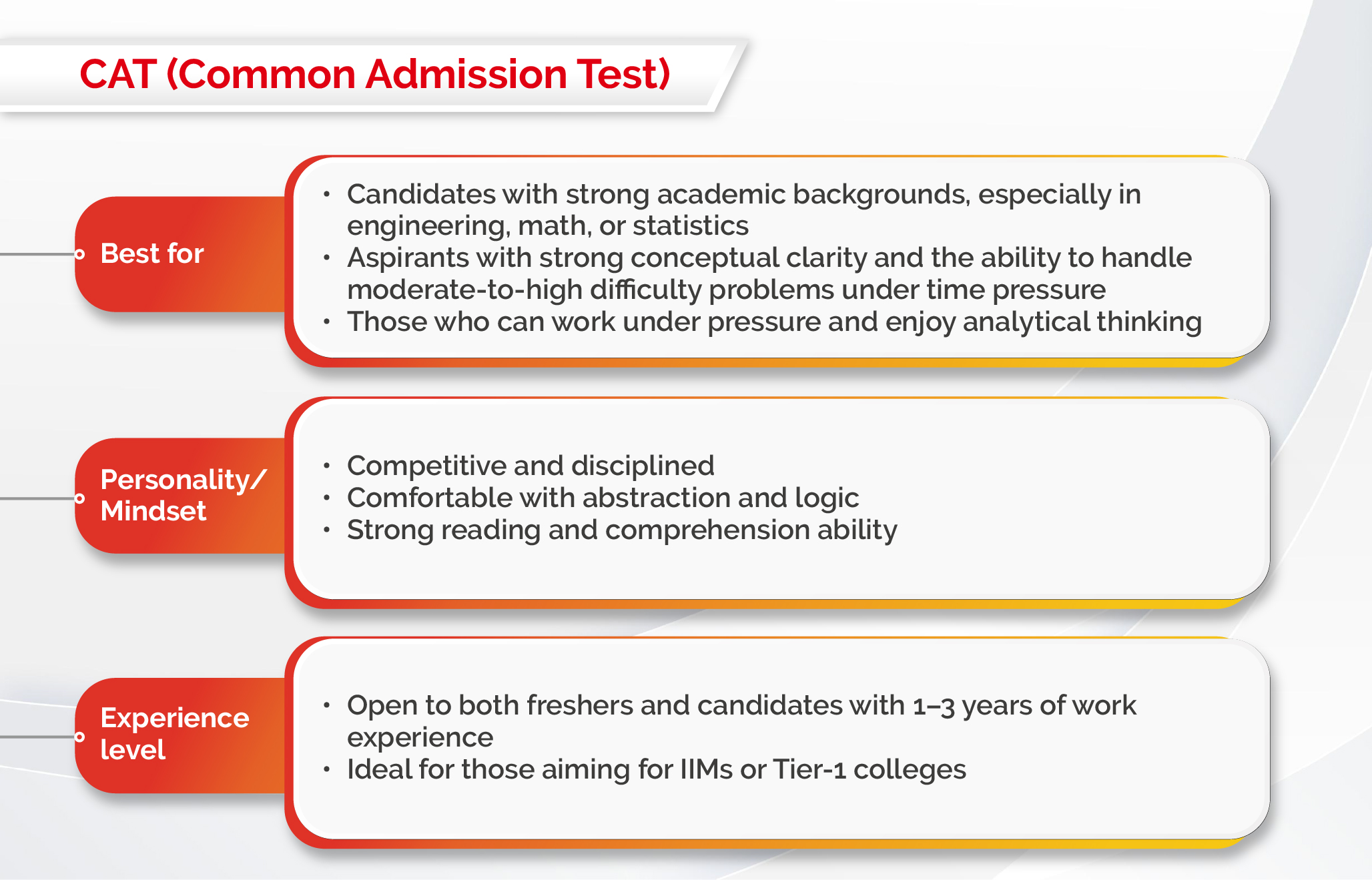
CAT (Common Admission Test)
|
Best for
- Candidates with strong academic backgrounds, especially in engineering, math, or statistics
- Aspirants with strong conceptual clarity and the ability to handle moderate-to-high difficulty problems under time pressure
- Those who can work under pressure and enjoy analytical thinking
Personality / Mindset
- Competitive and disciplined
- Comfortable with abstraction and logic
- Strong reading and comprehension ability
Experience level
- Open to both freshers and candidates with 1–3 years of work experience
- Ideal for those aiming for IIMs or Tier-1 colleges
|
Avoid if you dislike quantitative problem-solving or are uncomfortable with time-pressured problem sets
XAT (Xavier Admission Test)
|
Best for
- Students who are strong in logic, reading comprehension, and enjoy case-based and ethical problem-solving
- Ideal for humanities, commerce, or liberal arts backgrounds as well
- Those targeting XLRI, XIME, or schools with a strong ethical/business orientation
Personality / Mindset
- Introspective, ethical, and capable of nuanced decision-making
- Good reading habits and general awareness
- Comfortable with ambiguous questions and abstract reasoning
Experience level
- Welcomes both freshers and professionals; decision-making section suits those with work experience
|
NMAT by GMAC (NMIMS Management Aptitude Test)
NMAT is conducted by GMAC- Graduate Management Association Council , the same body that conducts GMAT
|
Best for:
- Aspirants looking for moderate difficulty, speed-based exams
- Candidates who want multiple attempts to improve scores
- Those targeting NMIMS, ISB Advanced Management Programs, and others
Personality/Mindset:
- Time-sensitive and process-driven
- Confident under pressure, willing to retake exams for better performance
Experience level:
- Especially good for working professionals looking to shift careers
- Flexible enough for freshers
|
MAT (Management Aptitude Test)
|
Best for:
- Aspirants seeking wide coverage and multiple opportunities (MAT is conducted 4 times a year)
- Candidates from non-engineering backgrounds, such as arts, commerce, or general sciences
- Those applying to B-schools below top tier institutes like the IIMs (including XIME and many others)
Personality/Mindset:
- Practical and focused on outcomes
- Better suited to those who prefer an exam that is less intense than CAT/XAT
- Prefer straightforward question types over tricky logic-based problems
Experience level:
- Excellent for freshers and early-career candidates
- Also helpful for candidates who want a fallback option along with CAT/XAT
|
CMAT (Common Management Aptitude Test)
|
Best for:
- Candidates who want a national-level test for AICTE-approved institutions
- Useful for those who missed CAT/XAT or want additional options
Personality/Mindset:
- Well-rounded with interest in GK, innovation, and quant
- Not looking to compete for IIMs but still want solid B-schools
Experience level:
- Suitable for both freshers and professionals
|
TISS-NET
|
Best for:
- Aspirants looking at social sector, HR, policy, and development
- Strong verbal skills and general awareness
Personality/Mindset:
- Socially aware, empathetic, community-driven
- Interested in impact careers more than corporate ones
Experience level:
- Ideal for graduates and early professionals seeking meaningful careers
|
SNAP
|
Best for:
- Candidates targeting Symbiosis institutions
- Comfortable with fast-paced, multiple-choice, moderate-difficulty exams
Personality/Mindset:
- Speedy and accurate
- Adaptable to different question types
Experience level:
- Freshers and early professionals
|
State Level Exams (MAH-CET, KMAT, etc)
|
Best for:
- Aspirants looking for regional colleges, affordability, and proximity
- Those not seeking national-level competition
Personality/Mindset:
- Practical, focused on ROI and regional placements
- Looking for colleges with good local industry connections
Experience level:
- Suitable for all experience levels
|
Section-Wise Strategies
A. Quantitative Aptitude
- What matters: Concepts, formulas, and solving speed
- How to master:
- Break topics by difficulty and start with Arithmetic.
- Use books like Arun Sharma (Quant) and Sarvesh Verma.
- Practice mental calculation and approximation techniques.
- Focus on conceptual clarity over rote formula application.
B. Verbal Ability and Reading Comprehension (VARC)
- What matters: Reading speed, vocabulary, comprehension accuracy
- How to master:
- Read newspapers like The Hindu, Mint, or New York Times daily.
- Practice 2 RCs per day; analyze why each option is right/wrong.
- Use flashcards for vocabulary (Apps: Magoosh, Anki).
- For grammar: Wren & Martin or Norman Lewis for basics.
C. Logical Reasoning and Data Interpretation (LRDI)
- What matters: Pattern recognition, multi-variable reasoning
- How to master:
- Start with puzzles (Sudoku, binary logic, seating).
- Move to caselets and DI sets involving percentages and ratios.
- Learn to choose the right sets to attempt in exams.
- Solve from previous CAT/XAT papers and TIME/IMS books.
D. Decision Making (specific to XAT)
- What matters: Ethical reasoning, prioritization, business sense
- How to master:
- Practice past XAT papers. There are no defined rules, but common sense and consistency in judgment are key.
- Focus on stakeholder analysis: what decision benefits most people ethically?
E. General Knowledge (for XAT, CMAT, IIFT)
- What matters: Awareness, not cramming facts
- How to master:
- Regularly read GK updates from apps like GKToday, Gradeup, or Manorama Year Book.
- Focus on business, economy, government schemes, international news.
- Practice quizzes weekly.
Practice Is Everything: Mocks & Analysis
Doing 40–50 full-length mocks is common among toppers.
How to make the most of mocks:
- Simulate real exam conditions: same time slot, no distractions
- Analyze each mock: Where did you waste time? Where were you inaccurate?
- Maintain a mistake log: Revisit every error weekly
- Use dashboards from coaching institutes (e.g., TIME, IMS, Career Launcher) to benchmark performance
Key Metrics to Track:
- Attempt rate vs. accuracy
- Time spent per section
- Net score vs. percentile estimate
- Sectional balance (no one section should lag too far behind)
Coaching vs. Self-Study: What Works?
Both paths can work well, depending on your personality and environment.
Choose coaching if:
- You need structured guidance and peer competition
- You struggle with self-discipline
- You want access to curated mocks and expert mentors
Self-study is viable if:
- You are a strong planner with good conceptual foundation
- You prefer learning through YouTube, books, and online platforms
- You can stick to your mock-and-analysis regimen
Some reliable coaching platforms:
- Offline: TIME, IMS, Career Launcher
- Online: 2IIM, Cracku, Unacademy, iQuanta
Specific Tips for CAT and XAT
For CAT:
- Be flexible: Sectional difficulty varies year to year. Don’t fixate on cutoffs.
- Focus on LRDI: This section often becomes the deciding factor.
- Build test-taking stamina: CAT is 2 hours of intense focus.
For XAT:
- Decision Making: Prepare this like a case-study paper.
- Essay (if asked): Practice 300-word opinion pieces with logical flow.
- GK matters: It may not have sectional cutoff, but top colleges use it in final selection.
Mental Preparation: Build Your Inner Game
Entrance exams are as much psychological challenges as academic ones.
- Stay consistent: Peaks of motivation are great, but persistence wins.
- Avoid burnout: Take breaks, go for walks, get good sleep.
- Control anxiety: Use breathing techniques, journaling, or speaking to mentors.
- Visualize success: Imagine your admit letter from your dream B-school.
Final Month Plan
The last month is mock-heavy.
- Take mocks every 2–3 days
- Alternate full-length and sectional mocks
- Revise notes and error logs
- Don’t overlearn new concepts - solidify what you already know
- Sleep early and avoid second-guessing your strategy
Common Pitfalls to Avoid
- Chasing too many resources: Stick to 1–2 good sources per subject
- Skipping mock analysis: Every test taken without analysis is a wasted opportunity
- Neglecting weak areas: Confront them head-on; don’t avoid them
- Comparing prep journeys: Everyone has a different learning curve
That being said, there’s been research to understand the correlation between your academic performance prior to the entrance exams and also your test scores and your MBA success.
- Entrance test scores (which measure aptitude) do have some predictive validity for MBA academic performance, but the effect size is modest.
- Prior academic performance (CGPA/GPA) sometimes shows equal or slightly better predictive power than entrance scores.
- Both measures—entrance exam and CGPA—alone are not sufficient to fully predict MBA success; many other factors (motivation, work‑experience, environment, pedagogy) matter.
Sources:
a.“A Study of Factors Impacting Success of Students in Entrance Examination for MBA Programme in Maharashtra” by Ramteke & Deshmukh
b.“A Correlational Study of MAT Score, IQ and GPA of MBA Students” by R. Kumar
Remember, entrance tests are the beginning of your management journey, not the destination. They open the door to institutes like IIMs, XLRI, or XIME, but your attitude, ethics, and adaptability will define how far you go.
You are not just preparing for an exam - you are preparing to lead, solve real problems, and make a difference. Respect the process, give it your best, and trust that your sincere effort will yield results.
Good luck - and see you on the other side of success.